
One scene, two kinds of author
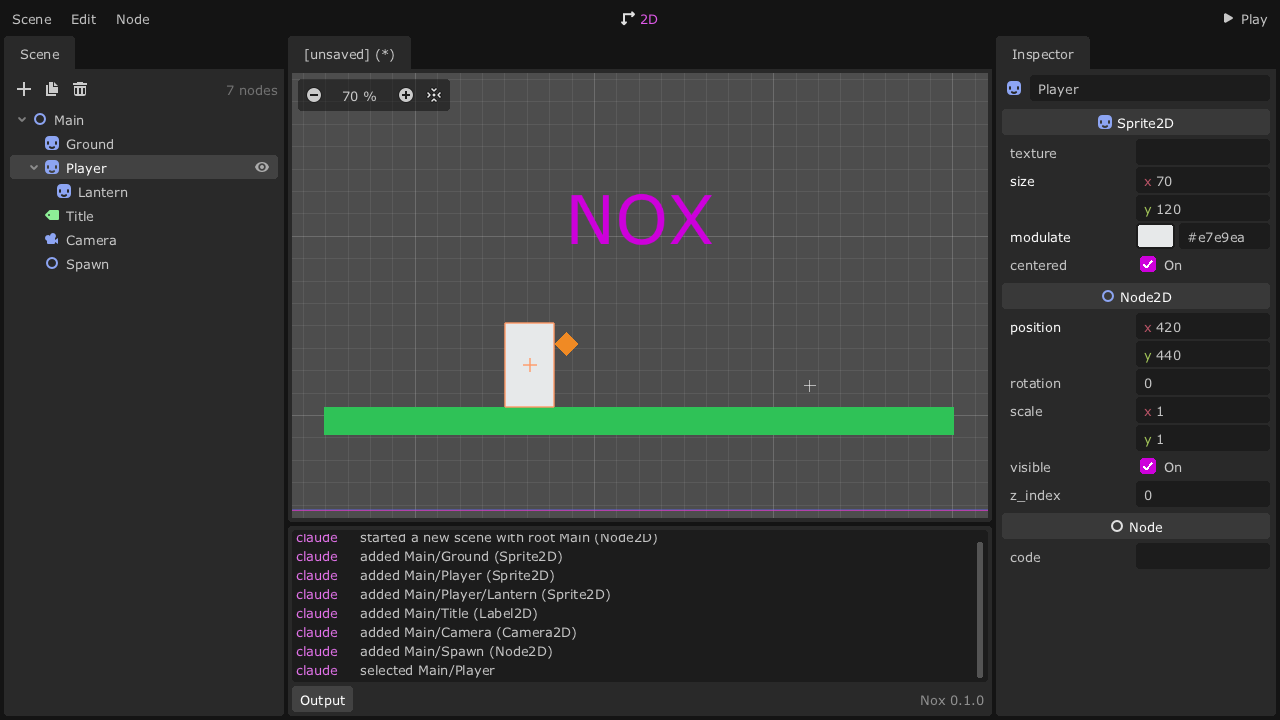
The person works in an editor laid out the way game developers expect. The agent works through commands. Both are editing the same live scene.
Game engine · by Spectre
Nox is the game engine Spectre is building for the games Arcana will host. It is written in plain C, and it is built so that a person and an AI agent can work on the same scene at the same time.
Nox is in development and there is no public download yet. The editor, the node system and the first of the interface, the game runtime and physics work today on Windows. Animation, sound, networking and 3D are still to come. The games on Arcana now were not made with Nox.
The person works in an editor laid out the way game developers expect. The agent works through commands. Both are editing the same live scene.
Each change is a named command with JSON in and JSON out, and the editor's own buttons run those same commands. There is nothing a person can do that an agent can't.
A change made by an agent appears in the editor as it runs. The output panel lists every change with who made it, and undo takes back the last one, whoever made it.
The engine is one program. nox edit opens the editor and nox call sends it a command, so anything with a shell can drive it.
nox serve is the editor's session without the window. The same commands work there, screenshots included, with no graphics card.
A bad edit comes back with what was wrong and how to fix it, and changes nothing. Commands list themselves, so an agent learns the editor from the editor.
nox edit                                   # a person opens the editor

nox call add type=Sprite2D name=Player 'props:={"position":[420,440],"size":[70,120]}'
nox call set path=Main/Player prop=rotation value=15
nox call screenshot file=shot.png          # a picture of the editor, to look at
nox call changes                           # what everyone has done, and who did it
nox call undo
The node appears in the editor as the command runs. Drag it somewhere else with the mouse, and the next nox call get answers with the new position.
| Part | What it does | State |
|---|---|---|
| Core | Memory, JSON, files, sockets and deterministic math. | Working |
| Scenes | A scene tree, signals and groups, 2D nodes, three kinds of physics body and 22 interface node types. Scenes are saved as JSON text that diffs cleanly, and one scene can sit inside another. | Working |
| Commands | Every edit is a named command, with one undo stack shared by everyone and a journal of who did what. | Working |
| 2D drawing | One draw list for shapes, fonts and widgets, drawn by the graphics card in a window or in software for screenshots. | Working |
| Interface | Anchors, containers, panels, labels, buttons, focus and scrolling. Text fields and themes come next. | First slice |
| Game runtime | Play runs the scene in a process of its own, with limited rights on Windows. Nodes run compiled C at a fixed 60 frames a second, and code is reloaded into the running game when a file changes. | First version |
| Physics | Nox's own solver: gravity and damping, soft contacts, warm starting and friction, for spheres, boxes and planes. No joints or sleeping yet. | First three slices |
| Editor | Scene dock, inspector, a 2D view with drag to move, output, menus, Play and Stop. | First version |
| Window | Windows today, through Direct3D 11. Written for macOS and Linux too, not yet built there. | Windows first |
In the order planned. None of these has a date.
The Arcana app for Windows is being built on Nox first, because it is mostly interface. NØKK is the first of Spectre's games planned to move to it.
In the meantime, play the games that are on Arcana now.